
Overview – AI is changing cybersecurity by making familiar threats faster, more convincing, and easier to scale. For enterprise leaders, the practical challenge is preparing cybersecurity teams, identity controls, employee training, vendor risk programs, and incident response plans for attacks that look more credible than they used to.
What Is AI Cybersecurity?
AI cybersecurity refers to the way artificial intelligence affects cyber risk, security operations, attacker behavior, employee behavior, and enterprise security planning.
At a practical level, the term includes two sides of the same problem. Security teams can use AI to detect patterns, analyze threats, support response, and improve visibility across large environments. Meanwhile, attackers can use AI to write more convincing phishing emails, impersonate trusted people, automate research, generate malicious code, and scale social engineering campaigns.
That is why AI cybersecurity should not be treated as a single software category. It touches identity security, cloud security, vendor risk management, employee training, data governance, compliance, incident response, and cybersecurity staffing.
The organizations that manage AI cybersecurity well will connect the technology risk to business behavior. After all, the weak point may not be the firewall. It may be the approval process, the help desk script, the vendor payment workflow, or the employee who thinks they are being helpful.
Human helpfulness remains undefeated as both a virtue and a security liability. A lovely little design flaw.
Why AI Cybersecurity Is Not Just a Technology Problem
AI cybersecurity is often discussed as if the solution is simply more software.
That is convenient. It is also incomplete.
AI-driven threats affect technology, people, workflows, access controls, vendor relationships, help desk procedures, executive communications, and incident response plans. For example, a fake email is not just an email problem. A deepfake call is not just a media problem. A convincing impersonation of a manager, recruiter, vendor, or finance leader can become a payroll issue, a data issue, a procurement issue, or a business continuity issue.
For that reason, AI cybersecurity has to be treated as an operational risk, not just a security tool selection exercise.
The organizations most exposed are not always the ones with the weakest firewalls. In many cases, they are companies with complex approval chains, distributed teams, outsourced IT functions, remote hiring processes, and fast-moving business units. In other words, normal enterprise life. Humanity has once again built an efficient system and then acted surprised when criminals found the seams.

How Is AI Changing Cybersecurity Threats?
AI is not replacing traditional cyberattacks. It is improving them.
Attackers still want credentials, access, money, intellectual property, sensitive data, and leverage. However, AI changes the quality and speed of the attack. A phishing campaign that once looked sloppy can now read like it came from a real colleague. A fake invoice can match the tone and formatting of a real vendor. Even a fraudulent message can reference company news, job titles, locations, and recent business activity.
That matters because many security controls still rely on people noticing when something feels wrong.
AI makes “wrong” feel more normal.
This is especially dangerous in environments where employees are trained to move quickly, serve customers, approve requests, support executives, and avoid becoming the bottleneck. Attackers know this. As a result, they exploit helpfulness, urgency, authority, and confusion. Apparently “being a decent coworker” is now an attack surface. Wonderful progress.
How Does AI Make Phishing More Dangerous?
Phishing is still one of the most common and effective cyberattack methods because it targets people, not just systems.
AI makes phishing more dangerous because it removes many of the old warning signs. In the past, poor grammar, awkward phrasing, strange tone, and generic messaging helped employees spot suspicious emails. Now attackers can generate polished, believable messages that match a company’s language, mimic a leader’s writing style, and adapt to different audiences.
AI-enhanced phishing can include:
- Personalized messages based on public LinkedIn profiles, company websites, press releases, and social media activity.
- Fake vendor communications that reference real projects, invoices, renewal cycles, or purchase orders.
- Recruiting scams that target candidates, HR teams, or hiring managers.
- Executive impersonation messages that create urgency around payments, credentials, or sensitive files.
- Multi-step campaigns that begin with harmless communication before escalating to a malicious request.
This is not just a higher-volume version of old phishing. Instead, it is a quality improvement problem. The message looks better, sounds better, and arrives with more context. As a result, the attacker gets more time before suspicion kicks in.
The practical response is not to tell employees to “watch for bad grammar.” That advice now belongs in the museum next to fax machines and passwords taped under keyboards. Companies need stronger verification habits, better email security, identity controls, and training that reflects how modern phishing actually works.

Businesswoman hands typing on laptop, woman face hologram and glowing biometric scanning on computer screen. Concept of face swapping, deep fake and impersonation
Why Are Deepfakes a Cybersecurity Threat?
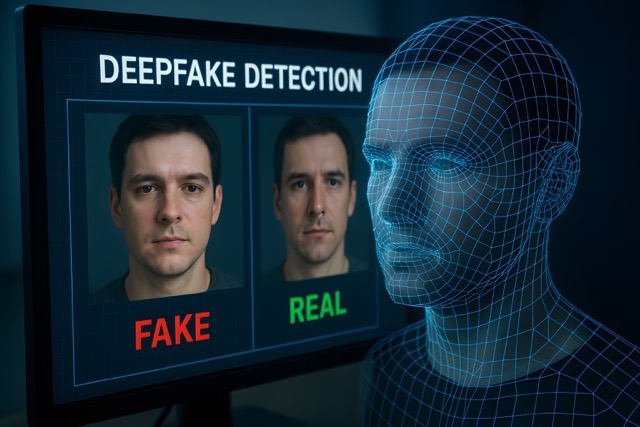
Deepfakes are AI-generated audio, video, or images that can make a person appear to say or do something they did not actually say or do. In cybersecurity, deepfakes are dangerous because they can be used to impersonate trusted people.
Deepfakes are no longer a weird internet novelty reserved for celebrity videos and people with too much free time. They are becoming a real business risk.
AI-generated audio and video can be used to impersonate executives, finance leaders, IT staff, vendors, or trusted partners. Even when deepfakes are not perfect, they may be good enough in the right context. A short voicemail, a quick video message, a noisy call, or a rushed request before a deadline may be all it takes. The attack does not need to win an Oscar. It only needs to create enough trust for someone to click, approve, transfer, disclose, or bypass a process.
The risk is especially high when organizations rely on informal approval habits.
For example, a finance employee may feel pressure to process a payment because the request appears to come from a senior leader. Similarly, a help desk technician may reset access because the caller sounds like a known employee. A project manager may share files because the message appears to come from a trusted vendor. These are not failures of intelligence. They are failures of verification design.
The defense is not panic. It is process.
Organizations need clear verification rules for sensitive actions. That includes payment changes, wire transfers, access resets, vendor banking updates, data exports, and executive requests. “I thought it sounded like him” is not an enterprise security control. It is barely a plot point.
How Does AI Lower the Skill Barrier for Attackers?
One of the most important AI cybersecurity risks is not that elite attackers become more dangerous. They probably do.
The bigger issue is that less-skilled attackers can become more capable.
Generative AI can help threat actors write better messages, translate campaigns into multiple languages, research targets, generate code snippets, summarize stolen data, automate reconnaissance, and test different versions of a lure. That does not mean every attacker is suddenly sophisticated. Instead, it means the baseline quality of attacks can rise.
This creates a volume and capability problem for security teams.
More attacks may look legitimate. Employees may be targeted with customized messages more often. Vendors may be impersonated with greater accuracy. Workflows may be probed for weak approval steps. As a result, the organization does not just need better technical controls. It needs better resilience across people, processes, and platforms.
This is where enterprise cybersecurity maturity starts to matter. Companies with weak access controls, unclear escalation paths, inconsistent vendor reviews, and underdeveloped security training may find that AI does not create their risk. It simply exposes the risk faster.
Why Identity Security Is Becoming the Main Battleground
AI-driven cybersecurity threats are tightly connected to identity.
Attackers increasingly want to log in, not break in. Stolen credentials, session tokens, social engineering, MFA fatigue, help desk manipulation, and fake identities can all help attackers gain access without triggering the same alarms as older intrusion methods.
AI makes identity attacks more convincing because it can support impersonation at scale.
A fake employee profile can look real. A fraudulent recruiter message can sound credible. A help desk request can include convincing personal details. Likewise, a vendor impersonation can match familiar language, and a fake executive message can create pressure. When identity is trusted too easily, attackers do not need to defeat the entire security stack. They just need to become someone the business already trusts.
This is why identity security, privileged access management, MFA, conditional access, and strong onboarding and offboarding procedures matter more than ever.
Companies that treat identity as an administrative task are going to have a bad time. By contrast, companies that treat identity as a security foundation will be in a much stronger position.
How Does Shadow AI Create Internal Cybersecurity Risk?
Shadow AI refers to employees using AI tools that have not been reviewed, approved, or governed by the organization.
AI is not only changing attacker behavior. It is also changing how employees work.
Teams are using AI tools to write emails, summarize documents, analyze spreadsheets, draft code, review contracts, support customer service, create content, and speed up research. Some of that use is approved. Some of it is improvised. Some of it is happening through free tools nobody in IT has reviewed. Naturally, humans saw a powerful new technology and immediately started pasting sensitive information into it. A timeless species.
This creates several internal risks:
- Sensitive data may be entered into tools without proper review.
- Employees may rely on AI-generated output without validation.
- Developers may introduce insecure code generated by AI tools.
- Business units may adopt AI applications without vendor risk review.
- Confidential information may be exposed through shadow AI use.
- Policies may lag behind actual employee behavior.
This does not mean companies should ban AI. That is usually unrealistic and counterproductive. Instead, organizations need clear AI usage policies, approved tools, employee training, data handling rules, and governance around how AI is used inside the business.
AI adoption without governance is not innovation. It is wishful thinking with a login screen.
Why Cybersecurity Staffing Becomes More Important
AI cybersecurity increases the demand for people who can connect the dots.
Tools matter, but tools do not automatically understand business context. They do not always know which executive request is unusual, which vendor payment change is suspicious, which access pattern violates policy, or which department is quietly using an unapproved AI platform.
Organizations need cybersecurity professionals who can interpret risk, improve processes, investigate suspicious behavior, tune controls, train employees, and work across IT, legal, HR, procurement, finance, and operations.
That requires talent with a blend of technical and business understanding.
The challenge is that many companies already struggle to find and retain cybersecurity talent. AI does not remove that pressure. In fact, it increases it. Security teams need people who understand identity, cloud security, threat detection, incident response, vendor risk, governance, and AI-enabled social engineering. Those people are not exactly stacked on shelves at the local talent warehouse.
This is where strategic workforce planning becomes critical.
Enterprise leaders need to understand which cybersecurity skills should be built internally, which can be supported through consultants, which roles can be filled through contract talent, and which specialized projects require outside expertise. AI cybersecurity is too important to treat as a future hiring problem. It is already affecting present risk.
What Cybersecurity Skills Matter Most in an AI Threat Environment?
AI cybersecurity requires a broader mix of skills than traditional perimeter defense alone.
Enterprise organizations need people who can manage identity risk, strengthen cloud security, investigate abnormal activity, assess vendor technology, create AI governance policies, and support incident response. Just as important, they need professionals who can explain cybersecurity risk in business language, because AI threats often cross department lines.
The most important skill areas include:
- Identity and access management.
- Cloud security and infrastructure protection.
- Security operations and threat detection.
- Incident response and digital forensics.
- Vendor risk and third-party technology review.
- AI governance and responsible AI usage.
- Employee security awareness and social engineering defense.
- Security architecture and policy development.
The right staffing model depends on the organization. Some companies need permanent cybersecurity leadership. Others need specialized contract talent for identity projects, cloud remediation, security operations support, tabletop exercises, or AI governance planning.
The point is not to hire randomly because AI sounds scary. Instead, the point is to match cybersecurity talent to the specific risks AI is increasing inside the business.
What Should Enterprise Leaders Do About AI Cybersecurity Now?
The practical response to AI cybersecurity is not panic buying more tools.
A better starting point is a disciplined review of where AI changes the risk profile of the organization. Leaders should focus on the areas where attackers are most likely to exploit trust, identity, access, and decision-making.
A strong starting point includes:
- Review approval workflows for payments, vendor changes, access resets, and sensitive data transfers.
- Strengthen identity controls, including MFA, conditional access, privileged access management, and offboarding.
- Train employees on AI-enhanced phishing, deepfakes, impersonation, and verification habits.
- Create clear policies for approved and unapproved AI tools.
- Evaluate vendor AI usage as part of vendor risk management.
- Update incident response plans to include deepfake, impersonation, and AI-enabled fraud scenarios.
- Build cybersecurity staffing plans around identity, cloud, threat detection, governance, and incident response skills.
- Run tabletop exercises that include executives, finance, HR, IT, legal, and operations.
The goal is not to make employees suspicious of everything. That creates its own problems, including the joyless workplace energy of a badly lit interrogation room. Instead, the goal is to make verification normal, fast, and culturally acceptable.
When employees know how to verify sensitive requests without feeling like they are being difficult, the organization becomes harder to manipulate.
The Real Risk Is Falling Behind Quietly
AI is reshaping cybersecurity threats in a subtle but important way.
It is not always loud. It is not always dramatic. In many cases, it may not announce itself as an AI-powered attack. It may simply arrive as a better email, a more believable voice message, a more polished fake identity, or a more convincing request from someone who appears to be trusted.
That is what makes it dangerous.
The companies that respond well will not be the ones that chase every AI headline. Instead, they will be the ones that strengthen identity, improve verification, train employees, govern internal AI use, and close cybersecurity staffing gaps before the threat landscape gets further ahead.
AI cybersecurity is not just about defending against new tools.
It is about preparing the organization for a world where deception is easier to produce, harder to detect, and faster to scale.
For enterprise leaders, the message is simple: the threat is changing quietly. The response should not.
FAQ
What is AI cybersecurity?
AI cybersecurity refers to the way artificial intelligence affects cyber risk, security operations, threat detection, and attacker behavior. It includes both the defensive use of AI by security teams and the offensive use of AI by threat actors. On the defensive side, AI can help analyze large volumes of security data, identify suspicious patterns, and support faster response. On the offensive side, attackers can use AI to create more convincing phishing messages, impersonate executives, automate research, and scale social engineering campaigns. The most important point is that AI cybersecurity is not only a technical issue. It also affects people, processes, identity, vendors, and governance. Organizations need policies, controls, training, and talent strategies that reflect how AI is changing the threat environment.
How is AI changing phishing attacks?
AI is making phishing attacks more polished, personalized, and difficult to recognize. In the past, employees could often spot phishing emails because the messages had poor grammar, strange formatting, or generic language. AI allows attackers to create emails that sound natural, reference real business details, and imitate the tone of trusted people or companies. This makes phishing more dangerous because the message may not feel suspicious at first glance. Attackers can also use AI to test different versions of messages and quickly scale campaigns across many targets. The best defense is not just telling employees to “be careful.” Organizations need stronger verification processes, better email security controls, identity protection, and regular training that reflects how modern phishing actually works.
Why are deepfakes a cybersecurity concern?
Deepfakes are a cybersecurity concern because they can be used to impersonate trusted people. An attacker may use AI-generated audio or video to pretend to be an executive, finance leader, IT employee, vendor, or business partner. The goal is usually to create trust and urgency so someone approves a payment, resets access, shares sensitive data, or bypasses a normal process. Deepfakes do not need to be perfect to succeed. In a rushed business environment, even a short fake voicemail or brief video message may be convincing enough. Organizations should respond by creating clear verification rules for sensitive requests. Payment changes, access resets, vendor banking updates, and confidential data transfers should never depend on voice or video recognition alone.
Does AI mean companies need completely new cybersecurity tools?
Not necessarily. AI may create a need for some new tools, but the larger priority is improving the fundamentals. Many AI-enabled attacks still rely on old weaknesses such as stolen credentials, weak identity controls, poor verification habits, untrained employees, shadow technology use, and unclear response procedures. Companies should review whether their current tools and processes are strong enough for more convincing and higher-volume attacks. That may involve improving email security, identity management, access controls, monitoring, endpoint protection, and incident response. It may also involve adding AI governance and deepfake response planning. Buying more software without improving processes and staffing usually creates more noise, not more security. Apparently dashboards are not a strategy, despite their strong emotional support role in meetings.
How does AI affect cybersecurity staffing?
AI increases the need for cybersecurity professionals who understand both technical controls and business risk. Security teams need people who can evaluate identity threats, investigate suspicious activity, govern AI tool usage, improve incident response plans, and train employees on modern social engineering tactics. AI can help automate some tasks, but it does not eliminate the need for skilled people. In many cases, it raises the bar. Companies need talent that can interpret risk, work across departments, and adapt security programs as attacker behavior changes. Because cybersecurity talent is already difficult to find, organizations may need a mix of internal employees, consultants, contract specialists, and project-based experts. The staffing strategy matters because AI cybersecurity is not a one-time project.
What should companies include in an AI cybersecurity policy?
An AI cybersecurity policy should explain which AI tools employees are allowed to use, what types of data can and cannot be entered into AI systems, who approves new AI tools, and how AI-generated output should be reviewed. The policy should also cover confidential information, customer data, intellectual property, regulated data, code generation, vendor tools, and employee responsibilities. A useful policy should be practical enough that employees can actually follow it. If the policy is vague, employees will improvise. If it is too restrictive, they may work around it. The best approach is to give employees approved options, clear rules, and simple examples. AI governance should help the business work safely, not turn every task into a legal seminar wearing a badge.
Why is identity security so important in AI cybersecurity?
Identity security matters because many modern attacks focus on logging in rather than breaking in. Attackers use stolen credentials, phishing, MFA manipulation, fake identities, and social engineering to gain access through legitimate-looking channels. AI makes this easier by helping attackers create more believable impersonations and more personalized requests. Once an attacker has valid access, it can be harder to detect the activity as malicious. That is why organizations need strong MFA, conditional access, privileged access management, regular access reviews, and fast offboarding. Help desk procedures are also important because attackers may try to manipulate support teams into resetting credentials or bypassing controls. In an AI-shaped threat environment, identity is not just an IT function. It is one of the main security battlegrounds.
How can companies prepare employees for AI-driven cyber threats?
Companies should train employees to recognize modern social engineering, but training should go beyond basic phishing examples. Employees need to understand that AI-generated messages may sound professional, accurate, and familiar. They should be taught to verify sensitive requests through approved channels, especially when money, access, credentials, confidential files, or vendor changes are involved. Training should include examples of deepfake calls, fake executive messages, vendor impersonation, recruiting scams, and help desk manipulation. The culture matters as much as the content. Employees should feel supported when they pause to verify a request. If people are punished for slowing down, attackers will exploit that pressure. Good training makes verification normal instead of awkward.
What role should executives play in AI cybersecurity?
Executives should treat AI cybersecurity as a business risk, not just a technical issue. Leadership needs to support policies, funding, staffing, training, and cross-department participation. Executives are also common impersonation targets, which means they should follow the same verification rules as everyone else. In some organizations, senior leaders unintentionally create risk by expecting immediate action on informal requests. That habit becomes dangerous when attackers can imitate executive communication. Leaders should help normalize verification and make it clear that employees are expected to confirm sensitive requests. Cybersecurity improves when leadership models the behavior it wants from the rest of the organization. A company cannot preach process and then run executive approvals like a hallway favor economy.
How can outside cybersecurity talent help with AI-related threats?
Outside cybersecurity talent can help organizations close skill gaps, accelerate projects, and bring specialized expertise to areas where internal teams are stretched. This may include identity security, cloud security, incident response, security operations, AI governance, vendor risk management, tabletop exercises, and employee training. Contract or project-based experts can be especially useful when the organization needs to move quickly but does not have the internal capacity to hire full-time staff. The key is to match the talent model to the risk. Some needs require permanent leadership. Others require specialized support for a defined project. AI cybersecurity is evolving quickly, so companies benefit from flexible access to people who understand both current threats and practical enterprise execution.