
Overview – Enterprise contingent workforce programs give large IT organizations the flexibility to move faster, fill skill gaps, and support major technology projects. But when outside talent is spread across teams, vendors, and budgets, executives can lose sight of who is doing the work, where costs are growing, and which projects depend on contractors. That lack of visibility creates hidden risk around delivery, security, vendor performance, and long-term workforce planning.
Why Enterprise Contingent Workforce Programs Need Better Oversight
Contingent workforce programs are built to solve real problems. They help large companies move faster, control costs, manage vendors, and find skilled people when full-time hiring is too slow.
But there is a bigger risk that is harder to see.
It sits between the teams using contingent workers, the people tracking the work, and the executives responsible for results.
In many large companies, everyone touches the contingent workforce program. Procurement may manage vendors. HR may manage worker rules. IT may manage project needs. Finance may track spend. Business leaders may approve the work.
But no one may have a full view of how the program is working across the company.
That is the blind spot.
And inside large IT organizations, that blind spot can affect delivery speed, budget control, worker quality, compliance, security, and long-term planning.
Why Enterprise Contingent Workforce Oversight Matters
An enterprise contingent workforce gives large companies access to flexible talent. That matters when IT teams need help with cloud projects, cybersecurity, ERP systems, data work, application development, infrastructure support, and other major projects.
The problem is that flexibility can turn into confusion.
One team brings in contract developers through one staffing vendor. Another team uses a different vendor for infrastructure support. A project team uses statement-of-work resources. A cybersecurity team adds consultants for urgent coverage.
Each group may have a good reason.
But over time, the company can end up with a large outside workforce spread across many departments, vendors, projects, and systems.
Each team sees its own piece.
Few leaders see the full picture.
That is why enterprise contingent workforce oversight is so important. Without it, executives may not know where talent is working, which vendors are doing well, where costs are rising, or where teams depend too much on contractors.
The Problem Is Not Contractors
The problem is not that large companies use contractors. In many cases, they should.
Technology teams need access to people with skills that are hard to hire, expensive to keep full time, or only needed for certain projects. A large IT portfolio moves too fast to rely only on permanent employees.
Contractors can be a smart solution.
The problem starts when contractor use grows faster than the company’s ability to manage it.
At first, it may not seem risky. A team brings in a contractor to meet a deadline. A vendor fills a gap. A project gets the technical skill it needs.
But over time, those small decisions add up.
The company may now have a large group of contract workers who are important to daily operations, but not fully visible to leadership.
That is when a useful staffing model becomes a hidden business risk.
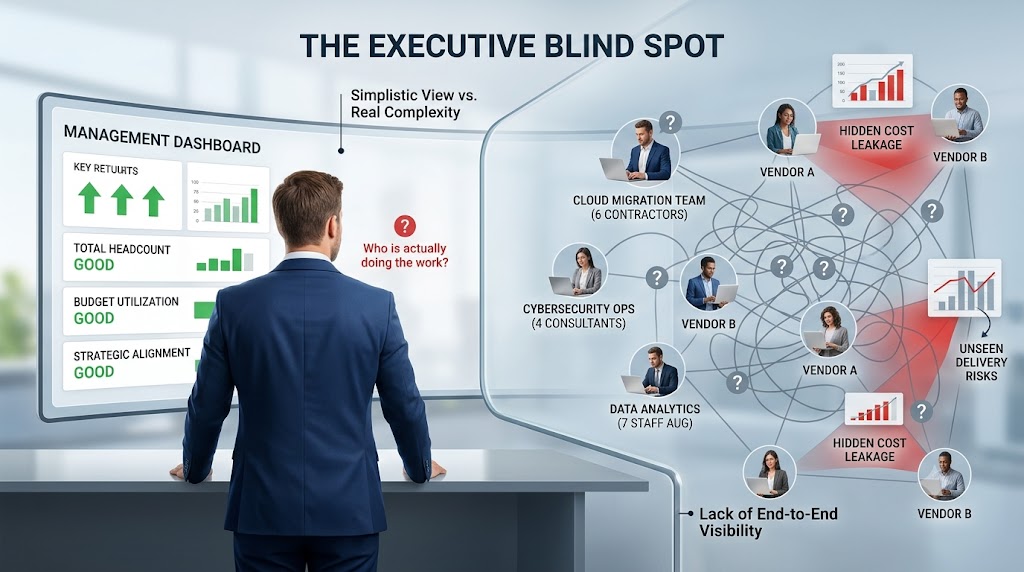
The Blind Spot Usually Has Several Parts
The blind spot inside an enterprise contingent workforce program is rarely one simple problem. It usually comes from several gaps at once.
1. Leaders Do Not Always Know Who Is Doing the Work
Executives may know the company uses contingent labor. But they may not know exactly where those workers are placed, what projects they support, how long they have been there, or how important they are to daily operations.
That creates risk.
A contractor may be “temporary” on paper but function like a core member of an infrastructure, cybersecurity, application, or data team.
If that person leaves, the company may suddenly realize that key knowledge was sitting with someone outside the full-time workforce.
This is not just a reporting issue.
It is a business continuity issue.
2. Spending May Look Controlled Even When It Is Not
Procurement teams may have rate cards, vendor contracts, approval steps, and invoice controls. Those are useful.
But they do not answer the larger question:
Is the company getting the right value from its contingent workforce spend?
A program can look controlled at the transaction level while still being weak at the enterprise level.
Different teams may pay different rates for similar roles. Vendors may overlap. Long-term contractor use may continue without anyone asking if there is a better workforce plan.
This kind of cost leakage is easy to miss. It does not always look like a budget disaster. Sometimes it just blends into the background, like bad office coffee and meetings where seven people discuss a spreadsheet that should have been an email.
3. Vendor Performance Is Often Measured Too Narrowly
Many enterprise staffing programs measure vendors with basic numbers:
- How fast did they submit candidates?
- How fast did they fill the role?
- Was the bill rate within range?
- Did they follow the process?
- Were invoices correct?
Those things matter.
But they are not enough.
For enterprise IT staffing, leaders also need to know if vendors are helping reduce project risk.
Better questions include:
- Are they providing people who can perform in complex IT environments?
- Are their candidates staying through the assignment?
- Are they helping with hard-to-fill skill areas?
- Are they improving hiring decisions?
- Are they reducing turnover, delays, and rework?
A vendor can look good on basic staffing numbers and still fall short where it matters most.
That is why contingent workforce oversight should measure quality, not just speed and paperwork.
4. Staffing Decisions May Not Match Business Priorities
In many companies, contingent workforce decisions happen close to the project level.
A manager needs help. A request is opened. A vendor submits candidates. Someone gets selected.
That works when the need is small and isolated.
It becomes a problem when the company is managing many IT projects across departments, systems, locations, and business units.
Without a clear connection between workforce planning and project priorities, leaders may not know if the right talent is going to the most important work.
High-priority projects may compete with lower-priority projects for the same scarce skills. Temporary staffing decisions become reactive instead of planned.
The result is easy to recognize:
- Too many urgent requests
- Too little planning
- Too much competition for the same talent
- Too many expensive last-minute decisions
- Too much “agility” that is really just scrambling in nicer shoes

Why This Matters More in Enterprise IT
This blind spot matters in any large company. But it is especially serious in enterprise IT.
IT contractors may work on core systems, sensitive data, cloud platforms, customer applications, development tools, security controls, and infrastructure.
That means weak oversight can create real risk.
Common risks include:
- Project delays when key roles take too long to fill
- Cost overruns when contractor use grows without review
- Knowledge loss when long-term contractors leave
- Security gaps when access rules are not managed well
- Compliance problems when worker rules are applied unevenly
- Poor delivery when vendors are measured only on speed
- Strategic drift when staffing decisions are not tied to business priorities
For CIOs and technology leaders, the question is not whether contingent labor is useful.
The real question is whether the company can see it clearly enough to manage it well.
Program Administration Is Not the Same as Oversight
Many large companies already have systems for managing contingent labor. They may use vendor management software, managed service providers, procurement workflows, HR rules, and approval processes.
Those tools can help.
But tools do not create oversight by themselves. Otherwise, every company with software would be brilliantly managed, and we all know how that fantasy ends.
Program administration answers basic questions:
- Was the request approved?
- Was the vendor allowed to fill the role?
- Was the worker onboarded correctly?
- Was the invoice processed?
- Was the rate within the approved range?
Those questions are important.
But strategic oversight asks bigger questions:
- Are we using contingent workers in the right places?
- Which projects depend most on contractors?
- Are we building internal skill or creating long-term dependency?
- Which vendors deliver the best IT talent?
- Where are skill gaps putting projects at risk?
- Are staffing decisions tied to our top IT priorities?
- What would happen if key contractors left tomorrow?
That second group of questions is where the blind spot usually appears.
The program may be managed.
The risk may not be.
How These Blind Spots Show Up
Most contingent workforce problems do not announce themselves early. They show up as symptoms.
A major IT project misses a deadline because a specialized role took too long to fill.
A team keeps extending contractors because no one has a plan to move knowledge back inside the company.
A vendor becomes deeply embedded in one department, but procurement only sees the invoices.
A cybersecurity contractor has access to sensitive systems, but access reviews are not consistent across teams.
Each issue may look manageable on its own.
Together, they point to a bigger problem.
The company has a contingent workforce program, but leaders do not have enough visibility into how that workforce affects cost, delivery, risk, and long-term planning.
What Stronger Oversight Looks Like
Better oversight does not mean adding more steps just to make everyone miserable. Large companies already have enough forms, approvals, and workflows wandering around pretending to be strategy.
The goal is not more process.
The goal is better visibility, clearer ownership, and smarter workforce decisions.
A stronger enterprise contingent workforce program usually includes these practices.
Clear Ownership Across Teams
No single department can manage the full picture alone.
Procurement may own vendor contracts. HR may own worker rules. IT may own skill needs. Finance may track spend. Business leaders may own project outcomes.
The problem is that shared involvement can easily become shared confusion.
Strong oversight requires clear ownership.
Leaders need to know:
- Who owns vendor performance?
- Who owns workforce planning?
- Who owns contractor risk review?
- Who owns access and offboarding standards?
- Who decides when contractor use has become long-term dependency?
Without that clarity, everyone is involved, but no one fully owns the result.
That is how companies end up with twelve stakeholders, five dashboards, and still no clear answer.
Better Reporting at the Portfolio Level
Executives need more than total headcount and spend summaries.
They need reporting that connects contingent workforce use to business and IT priorities.
Useful reporting should show:
- Which projects depend on contractors
- Which roles are hardest to fill
- Which vendors are producing the best results
- Which assignments are being extended again and again
- Where contractor spend is concentrated
- Where teams may be creating long-term dependency
- Where key knowledge sits outside the full-time workforce
The goal is not to bury leaders in dashboards.
The goal is to help them see patterns before those patterns become expensive problems.
Stronger Vendor Performance Reviews
Enterprise IT staffing vendors should be measured on more than how fast they send resumes.
Speed matters. But quality matters more.
A strong vendor should help the company improve hiring decisions, reduce turnover, and support critical IT work.
Vendor reviews should look at:
- Candidate quality
- Retention during assignments
- Fit for complex IT environments
- Support for hard-to-fill roles
- Communication with hiring managers
- Understanding of enterprise IT needs
- Ability to reduce delivery risk
A staffing partner that understands enterprise IT can help managers avoid bad hires, unclear role requirements, and repeat searches.
That is a lot more valuable than simply filling an open seat fast.
Workforce Planning Before the Emergency
Many contingent workforce decisions happen under pressure.
A team is behind. A skill is missing. A deadline is close. A manager needs someone now.
That urgency is real.
But if every staffing decision is reactive, the company never gets ahead of the risk.
Stronger oversight means looking across the IT portfolio and asking where future talent needs are likely to appear.
For example, if the company is investing in cloud, cybersecurity, AI, ERP, or data modernization, leaders should understand the staffing needs before every team starts chasing the same limited talent.
Workforce planning should not begin when the job request opens.
By then, the clock is already winning.
The Role of a Strategic IT Staffing Partner
A strong IT staffing partner can help reduce the blind spot.
The right partner brings market knowledge, role expertise, candidate insight, and better process discipline into the program.
For enterprise companies, a staffing partner should do more than respond to job orders.
A stronger partner should help leaders:
- Understand talent availability
- Clarify role requirements
- Identify hard-to-fill skill gaps
- Improve candidate fit
- Reduce contractor turnover
- Support better workforce planning
- Lower delivery risk on important IT projects
This matters because enterprise IT roles are not interchangeable.
The skills needed for architecture, implementation, testing, cybersecurity, cloud operations, data governance, and support are all different.
Treating them like they are the same is how projects get slow, expensive, and weird.
A good staffing partner helps leaders make better decisions before those decisions turn into delivery problems.
Questions Executives Should Be Asking
Executives do not need to manage every detail of the contingent workforce program.
But they do need enough visibility to know whether the program is helping or hurting the business.
Good questions include:
- Where are we most dependent on contingent IT talent?
- Which projects would be most affected if key contractors left?
- Which vendors consistently deliver the best people?
- Are we tracking contractor tenure?
- Are we planning for knowledge transfer?
- Are staffing decisions tied to our most important IT projects?
- Are we using contractors for temporary needs or hiding permanent skill gaps?
- Do we have consistent onboarding and offboarding rules?
- Are access and security reviews handled the same way across teams?
- Are vendors measured on quality, not just speed and cost?
These questions move the conversation from “How many contractors do we have?” to “How well are we managing the people helping run our technology environment?”
That is the conversation executives actually need.
The Risk of Waiting Too Long
The blind spot inside an enterprise contingent workforce program often stays hidden until something breaks.
A project misses a deadline.
A key contractor leaves.
A vendor underperforms.
A budget review exposes rising spend.
A compliance issue shows up.
A security concern appears during an access audit.
By then, the company is no longer fixing a visibility issue. It is responding to a business problem.
That is the real cost of weak oversight.
The company loses the chance to manage the risk early.
Final Thought
An enterprise contingent workforce can be a major advantage.
It gives large companies access to specialized skills, flexible capacity, and faster support for changing IT needs.
But that advantage depends on visibility.
When executives cannot see where contingent workers are used, how vendors perform, where costs are growing, and which projects depend on outside talent, the program becomes harder to manage.
The answer is not to stop using contractors.
The answer is to manage the contingent workforce with the same care given to technology strategy, vendor risk, and project planning.
Because in large IT organizations, the contingent workforce is not a side issue.
It is part of how the work gets done.
And if leaders cannot see it clearly, they cannot manage the risk clearly.
SEO Elements
SEO Title: Enterprise Contingent Workforce Oversight: The Executive Blind Spot
Meta Description: Enterprise contingent workforce programs can hide risks. Learn how better oversight helps IT leaders manage costs, vendors, contractor dependency, and project delivery.
Focus Keyword: enterprise contingent workforce oversight
Primary Keyword: enterprise contingent workforce
Suggested URL Slug: /blog/enterprise-contingent-workforce-oversight/
Suggested Categories: Enterprise IT Staffing, Contingent Workforce, IT Workforce Strategy
Suggested Tags: enterprise contingent workforce, contingent workforce oversight, IT staffing strategy, enterprise IT staffing, workforce risk, vendor management
Excerpt: Enterprise contingent workforce programs give IT leaders flexibility, but weak oversight can create hidden risks around cost, vendor performance, contractor dependency, and project delivery.
FAQ
What is an enterprise contingent workforce?
An enterprise contingent workforce includes non-permanent workers used across a large company. These may include contractors, consultants, temporary workers, project-based specialists, and other outside talent.
In IT, this workforce often supports cloud projects, cybersecurity, software development, infrastructure, data, ERP systems, and other important technology work.
Why is enterprise contingent workforce oversight important?
Enterprise contingent workforce oversight is important because large companies often use outside talent across many teams, vendors, and projects.
Without strong oversight, leaders may lose track of costs, contractor dependency, vendor performance, compliance, security access, and whether staffing decisions match business priorities.
What is the biggest risk in a contingent workforce program?
One of the biggest risks is lack of visibility.
Executives may not know where contractors are working, which projects depend on them, how long they have been there, or whether vendors are delivering the right quality of talent. This can create hidden risks around cost, delivery, compliance, and business continuity.
How can IT leaders improve contingent workforce oversight?
IT leaders can improve oversight by connecting workforce reporting to project priorities, reviewing vendor performance, tracking contractor dependency, improving knowledge transfer, and planning future staffing needs earlier.
The goal is not more paperwork. The goal is better decisions.
What should enterprises look for in an IT staffing partner?
Enterprises should look for an IT staffing partner that understands complex technology environments, delivers strong candidates, supports hard-to-fill roles, communicates clearly, and helps reduce project risk.
A strong partner should help improve workforce decisions, not just submit resumes quickly.